


History & Culture
How to Recognize Real Damascus Steel Forged from an Industrial Imitation: The Guide to Avoiding Summer Market Traps
Summer is back, with its medieval festivals, artisan markets, Viking camps, and “handmade knife” stands. And unfortunately, with them also return fake, forged knives, industrial “Damascus” sold as traditional forge pieces, and well-rehearsed sales speeches aimed at tourists.
For someone unfamiliar with the craft, it can be very difficult to tell the difference between a truly hand-forged blade and a blade simply machined or industrially cut. Yet there are several very visible clues. The Damascus pattern itself is often one of the best indicators.
In this article, we will see how to recognize real forge work, understand what Damascus steel truly is, and why history has already shown the dangerous limits of machined parts replacing forged parts.
Damascus Steel: A Beautiful Pattern… but Often Misleading
Today, the word “Damascus” has become a marketing argument.
You can find “Damascus” knives everywhere for €30, €50, sometimes even less. Visually, they look impressive: metallic waves, complex designs, black and silver contrasts… Yet in many cases, these patterns are only industrial decoration.
Real Damascus steel is obtained by forging several layers of different steels, forge-welded together at high temperature, then folded, twisted, or stretched. The pattern comes directly from the internal structure of the metal.
Fake Damascus is often:
- chemically etched;
- laser printed;
- industrially rolled;
- or made with a purely decorative purpose.
The problem is that a pattern can look spectacular without the blade having any real forging quality.
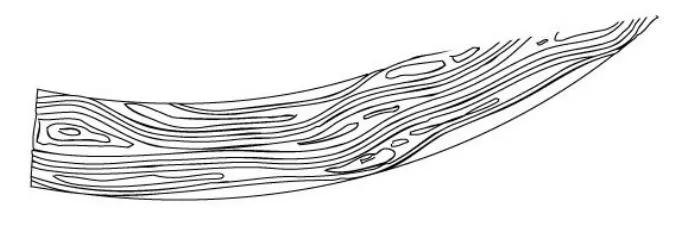
Below is a classic Damascus bar pattern example so you can clearly visualize each case.
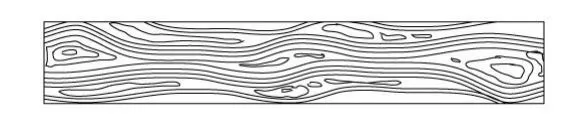
The Visible Difference Between Forged Damascus and Machined Damascus
1. The Pattern Must “Live” Inside the Blade — Here is an Example of the Very Best!
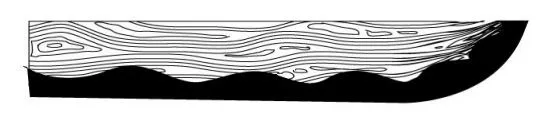
On a real forged blade:
- The Damascus lines follow the blade’s shape;
- They deform naturally;
- They follow the edge curves;
- They are never perfectly repetitive.
- In the example above, there is a welded cutting edge, ensuring good carbon content on the edge.
The metal has been stretched, compressed, and hammered. The pattern literally tells the blacksmith’s work.
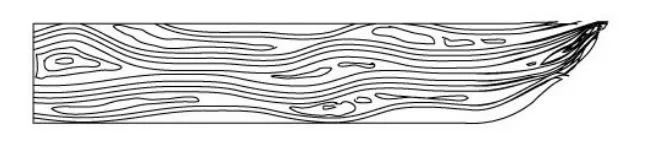
In the following example, the knife tip is indeed forged but without a welded edge, so since the Damascus process required several high-temperature heats, your knife may not keep a razor-sharp edge for very long.
On an industrial blade:
- The patterns are often too regular.
- Identical from one blade to another;
- Visually “flat”;
- Sometimes abruptly interrupted.
You often see designs that look more like metallic wallpaper than a living structure.
2. Observe the Spine of the Blade
This is probably the best test.
Real Damascus goes through the entire material. The pattern should therefore remain visible:
- On the spine of the blade;
- Near the cutting edge;
- Sometimes even in polished areas.
If the pattern completely disappears on the edge or seems only applied on the surface, be cautious.
Some cheap blades are simply acid-etched on the surface to create the illusion of Damascus.
Here are two examples of machined blades to avoid. On the first one, the tip was ground with an angle grinder — that is not a blacksmith’s work!
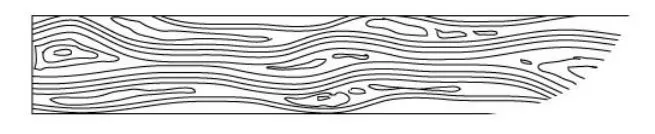
And here, the Damascus bar was twisted so the pattern follows the edge, while the spine was ground away, so it is not very good work.
3. Irregularities Are Normal
A real forge leaves human traces:
- Slight asymmetries;
- Small variations;
- Imperfect transitions.
A perfectly uniform knife, without any variation, sold as “hand-forged craftsmanship,” should immediately raise suspicion.
Forging is not an industrial printer.
Why Forging Truly Changes Metal Strength
Forging is not only used to “give shape.”
When metal is forged correctly:
- The internal fibers reorganize;
- Stresses distribute better;
- Mechanical resistance increases;
- The part withstands shocks and vibrations better.
On the contrary, a part simply machined from a block may retain:
- Internal stresses;
- Weaknesses;
- More brutal fractures.
This is especially true for parts exposed to vibrations or repeated stress.
The Famous Example of the Titanic Rivets
Industrial history provides a famous example: the RMS Titanic.
During modern investigations into its sinking, several researchers studied the quality of the materials used on the ship. Some rivets used in certain sections of the vessel had lower quality, with more impurities in the metal, especially slag.
Under the extreme stress caused by the collision with the iceberg, some rivets may have failed more easily, opening the hull plates.
However, historical precision matters. The issue was not simply “forged versus machined.” At the time, many rivets were actually installed by hand. The real issue mainly concerned:
- metal quality;
- manufacturing methods;
- and the industrial limitations of the time.
But this example remains interesting because it helps us understand one essential reality: the way a metal part is manufactured directly influences its strength.
The Trap of Medieval and Summer Markets
At summer markets, many sellers play on fantasy imagery:
- “Viking steel”;
- “Ancestral forging”;
- “Japanese Damascus”;
- “Handmade”.
Yet a large part of the knives sold:
- come from industrial imports;
- are laser cut;
- assembled on production lines;
- Then simply visually “aged”.
Ironically, a real craftsman will usually gladly show:
- The manufacturing steps;
- The grinds;
- The heating stages;
- The welds;
- The forge marks.
While sellers of industrial products often avoid technical details.
The Right Questions to Ask Before Buying
Before buying a knife presented as forged or Damascus, ask a few simple questions:
- What steel is used?
– A real bladesmith knows his steel grades precisely. - Is the Damascus forge-welded?
– Or simply etched? - Can we see the spine of the blade?
– It is often revealing. - Was the knife heat-treated after forging?
– Quenching and tempering are essential. - Does the seller forge the blades himself?
– Many simply assemble imported blades.
A Real Forged Knife Is Not Perfect…
And That Is Often a Good Sign
The modern paradox is that many people associate craftsmanship with industrial perfection.
Yet a true forged blade often has:
- Personality;
- Nuances;
- Slight differences;
- Traces of human work.
That is exactly what distinguishes it from a standardized product.
A real forged knife is not just a cutting object. It is a piece of metal transformed by fire, hammer, and experience.
And no laser engraving will ever fully imitate that.
FAQ
Yes, but caution is necessary. An extremely low price is often incompatible with the real time required to forge genuine handmade Damascus steel.
No. The pattern may be purely decorative.
Not at all. Some excellent industrial blades exist. The problem mainly appears when an industrial product is sold as handmade forged craftsmanship.
